No time to dive deep? Here’s the snack-sized version!
Fairbanks: Golden Heart of the Interior
Fairbanks blends frontier spirit with Arctic adventure. Discover rich gold rush history, thriving Alaska Native culture, and top attractions like the Riverboat Discovery, Gold Dredge 8, Fountainhead Antique Auto Museum and the University of Alaska’s Museum of the North. In summer, bask in 21-hour daylight; in winter, chase the Aurora Borealis under star-filled skies. With a warm welcome, small-town charm, and access to the Arctic wilderness, Fairbanks offers a true taste of Interior Alaska.
Fairbanks Alaska offers visitors small-town hospitality and a pioneer spirit that will make your stay one to remember. Fairbanks is Alaska’s second largest city with a population of 32,000 and a Borough population of almost 100,000, including the nearby military bases. Fairbanks is often called the “Golden Heart City” or the “Golden Heart of Alaska” because of both its gold rush history and its warm welcome it gives visitors.
Fairbanks is the hub for Alaska’s Interior and Arctic and is known for its first-class accommodations and restaurants, museums, concerts, historic sites, Alaska Native culture, and access to the Alaskan wilderness. It is also famous for its incredible long summer days, where the sun never seems to set. In June Fairbanks sees over 21 hours of sunlight. Of course, in the winter, the opposite is true, and there are very long, dark days. In December, there will be less than 4 hours of daylight in Fairbanks.
If you want to plan your own custom Itinerary that includes Fairbanks, try our Free Alaska Travel Planner. Select from pre-planned routes or select only the towns and cities you want to visit and get a complete list of accommodations and activities that match your interests.
In 1901 Captain E.T. Barnette disembarked from the steamship, Lavelle Young, and set up a temporary trading post on the banks of the Chena River. His temporary post became permanent the following year when Felix Pedro discovered gold in the nearby hills. The Gold Rush was on and Fairbanks was flooded with miners from all over the world determined to strike it rich.
In 1903 Fairbanks was incorporated as a City and was named after Indiana Senator Charles Fairbanks, who later became Vice President. Now, “discovery day” is commemorated each year with a fun, family friendly celebration in July called Golden Days. There is a street fair, Alaska’s largest parade and even a rubber ducky race down the Chena River.
There is still active mining in the area and glimpses of the past can be seen along the Steese Highway in the tailing piles leftover by the gold dredges.
Fairbanks, AK is also the home of several world class attractions. The Riverboat Discovery is consistently rated one of the top boat tours in the State and Gold Dredge 8 is also a visitor favorite. The Antique Auto Museum at the Wedgewood Resort has an amazing collection of vintage automobiles, historical photos and period costumes. Finally, don’t miss The University of Alaska Fairbanks ‘Museum of the North’ as it is one of the best museums in the State.
Each June 21st, Fairbanks hosts the Midnight Sun Festival, Alaska’s largest one-day event. More than 30,000 people gather to enjoy live music, local food and shopping on the longest day of the year.
Fairbanks not only has plenty of things to do in the summer months, but during the winter it is one of the best places in the world to view the Aurora Borealis (Northern Lights). It is near the Arctic Circle, which makes the Northern Lights visible from September to April.
The Morris Thompson Cultural and Visitors Center is at 101 Dunkel Street in historic downtown Fairbanks. It is home to Explore Fairbanks the organization that oversees the Visitor Center. The 9,000 square-feet of interpretive space features exhibits on the land, the seasons and the peoples of Interior Alaska and the Arctic. The MTCVC is open seven days a week from 8am to 9pm in summer and 8am to 5pm in the winter. Free Wi-fi for visitors. 907-456-5774 or 800-327-5774 www.explorefairbanks.com
Fairbanks Alaska Public Lands Information Center. Information on accessing public lands in Alaska state and federal parks, forests and refuges. 101 Dunkel Street. Located in the Morris Thomson Cultural & Visitors Center. It offers scheduled films and special events & programs throughout the year. A variety of educational programs are available. Summer hours daily 9 to 5 from Memorial Day to Labor Day. Call 907 459-3730 www.alaskacenters.gov/fairbanks.cfm
When you visit Fairbanks, you won’t have any difficulty in filling your time. You could spend a week here and still never get bored.
Day 1 – An excellent start to your time in Fairbanks is to stop at one of TripAdvisor’s top-rated attractions, the Morris Thompson Cultural and Visitor Center (MTCVC) located in downtown Fairbanks. The Center focuses on the cultural and historical aspects of life in Alaska using film, books and exhibits. A well informed and friendly staff can help you plan your trip in Fairbanks and area. The MTCVC is also a great access point to miles of walking trails, including a lovely walk along the Chena River. The downtown area is easily walkable and has many good restaurants and interesting shops to explore.
An excellent afternoon plan is to spend time with the Binkley Family on their world class tour, the Riverboat Discovery. It is a fascinating tour into the history of the Riverboats and their impact on the Fairbanks area.
Day 2 – Begin with a visit to TripAdvisor’s # 1 rated attraction in Fairbanks, the Fountainhead Antique Auto Museum. This is far more than just a place for old cars! It is a fantastic collection of photos, period costumes as well as some amazing automobiles. Another excellent tour that explores Fairbanks gold rush past is Gold Dredge 8. You’ll ride a narrow-gauge train to a historical Gold Camp that includes a Gold Dredge, old mining equipment and an opportunity to pan for gold; and keep what you find.
Day 3 – A trip to Fairbanks isn’t complete without a visit to Alaska’s theme park, Pioneer Park. Built to commemorate the 100-year anniversary of Alaska’s purchase from Russia. The 44-acre Park was opened in 1967 and has been a Fairbanks meeting place ever since. It is home to museums, shops, dining and a variety of fun activities such as mini-golf and the Palace Theatre Show. There are fast food vendors, restaurants and the Alaska Salmon Bake which has been serving up delicious Alaskan Salmon for over 40 years.
If you’re looking for a lovely, quiet place for a walk, be sure to check out Creamers Field or the Georgeson Botanical Gardens. The Botanical provides valuable horticultural information to people living and growing plants in this subarctic region.
Day 4 – If your trip to the northern parts of Alaska won’t be complete without a trip to the Arctic, we recommend taking a tour with Northern Alaska Tour Company. You can choose from one to multiple day itineraries from Fairbanks to the Arctic in large and small passenger vans and small planes. Their guests rave about the experience whether it be in summer or winter.
This resort offers residential-style 1 & 2 bedroom suites and is perfect for both nightly visits and extended stays. Located minutes from downtown Fairbanks and the University of Alaska Fairbanks.
Bear Lodge at Wedgewood Resort offers large guests rooms in quiet surroundings from mid-May to mid-September. Enjoy the tranquil surroundings of the beautifully landscaped flower gardens or get away from it all and head to the Fitness Center. There is complimentary Wi-fi and 24 hour courtesy van to the airport or Alaska Railroad Depot.
Well known to locals and visitors for providing outstanding guest service, spacious suites, 24-hour fitness room, ideal location and a fantastic restaurant. As part of Fairbanks’ locally owned hotel group, Fountainhead Hotels, Sophie Station Suites is typically geared toward business travelers given its high-tech perks and easy access to the airport. But families might get even more out of the 148 suite hotel, which has made a name for itself by looking out for the little details, from fresh flower arrangements and beautifully landscaped gardens to fantastic meals in Zach’s Restaurant.
Located on the banks of the Chena River, Fairbanks Princess Lodge is the choice of experienced travelers to Fairbanks. The Edgewater Dining Room and Trackers Bar & Grill have great food. Gift shop, espresso bar & fitness center, free wireless internet access, and a seasonal tour desk.
Westmark Fairbanks Hotel sets the standard for comfort and hospitality. With a convenient location, the hotel is prepared to meet your every need. Amenities include Red Lantern Steak & Spirits, meeting facilities, fitness center, gift shop, and free parking. 813 Noble Street. 907-456-7722, 800-544-0970 or westmarkhotels.com.
About an hour east of Fairbanks at the end of Chena Hot Springs Road, this natural hot springs resort is one of Interior Alaska’s signature experiences — soaking in the mineral-rich Rock Lake pools while the Northern Lights move overhead in winter is a bucket-list moment for many visitors. Beyond the springs, the resort runs the Aurora Ice Museum (kept below freezing year-round with martinis served in ice glasses), a geothermal renewable energy tour, greenhouses growing produce using the springs’ heat, and dog sled and ATV tours. It works well as either a day trip or an overnight stay.
This nationally recognized museum pairs a rotating collection of pristine early-1900s automobiles with over 150 pieces of period clothing and photography documenting how Alaskans actually lived and traveled during the motoring era. It’s not just a car museum but also a social history of early Alaska told through vehicles. It regularly earns top rankings from TripAdvisor and Lonely Planet for one of Fairbanks’ top attractions. It re-opened in 2026 in a new location in central Fairbanks.
Run by the Binkley family for four generations, this sternwheeler cruise on the Chena and Tanana Rivers is consistently rated among Alaska’s top tours. The narrated trip includes a bush pilot flying demonstration, a stop at a recreated Athabascan village with cultural demonstrations, and a look at Iditarod champion Susan Butcher’s former dog kennel. This tour gives visitors river scenery, aviation history, and Native culture in a single three-hour outing.
This free, 44-acre park was built for Alaska’s 1967 centennial and functions as a living history village: a relocated Gold Rush-era town, the historic SS Nenana sternwheeler (one of only two such vessels left in the country), the Pioneer Air Museum, artisan shops, mini-golf, and the long-running Alaska Salmon Bake. Individual attractions inside the park charge admission, but simply wandering the grounds costs nothing, making it an easy stop to fill an afternoon or evening at any budget.
A National Historic Site, Gold Dredge 8 puts visitors aboard a narrow-gauge train to a historic mining camp built around a massive dredge that once processed tons of gold-bearing gravel. Guided tours explain the mechanics of dredge mining, and every visitor gets a poke of paydirt to pan themselves, keeping whatever gold they find.
This local tour company offers sightseeing excursions throughout Alaska’s Arctic, with a fleet of first-class touring vans, 25-passenger coaches and flight seeing aircraft. One day and multi-day excursions are available both during summer and winter.
The University of Alaska Museum of the North is the Interior’s premier cultural and natural history stop, and the only research museum of its kind in the state. Its Rose Berry Alaska Art Gallery spans Alaska Native and contemporary art, while the natural history side includes the state’s largest public gold display and Blue Babe, a 36,000-year-old mummified steppe bison pulled from permafrost. A suspended 43-foot bowhead whale skeleton — the only one on display in the Americas — anchors the atrium, and the building’s angular, glacier-inspired architecture is a destination in itself. The museum’s west end is also getting the Walt and Marita Babula Planetarium, set to be the farthest north planetarium in North America when it opens to the public in spring 2026. The 65-seat, 11-meter dome theater will offer an immersive 360-degree full dome experience with 4K projection and 5.1 surround sound.
Come get lost in the world of dogs, just outside of Fairbanks, half-way to Chena Hot Springs, The Last Frontier Mushing Co-op offers experiences that capture the breathtaking beauty of Alaska, through both the landscape & Alaska’s rich heritage. They offer day mushing tours or a magical private Aurora tour for an unobstructed view of the Northern Lights in Winter.
17 miles east of Fairbanks The recreation area is managed as two units, the Lake Park and the River Park. Each has two campground loops, 86 campsites, some pull throughs for RV’s, with water, bathrooms, dump station. Each park also has a boat launch and extensive picnic areas, which include covered pavilions. Chena Lake also has a designated swimming area and boat dock.
Set inside the historic Lacey Street Theater downtown, this refrigerated gallery showcases larger-than-life ice sculptures carved by championship ice artists, some of whom work live on new pieces while narrating their technique. It’s open May through September, making it a clever way to experience Fairbanks’ ice-carving tradition during the summer.
Only 15 minutes south of Fairbanks in North Pole Alaska is Santa Claus House. One of Alaska’s most famous gift shops. Find amazing Christmas displays year-round and check out the Antler Academy where you can meet real live reindeer.
Morris Thompson Cultural and Visitors Center
Downtown at 101 Dunkel Street, the Morris Thompson Center is much more than just a visitor information stop. its 9,000 square feet of interpretive exhibits cover the land, seasons, and Native peoples of Interior Alaska and the Arctic in depth, making it a worthwhile stop. It also houses the Alaska Public Lands Information Center, screens films on Alaska’s regions, and anchors a network of downtown walking trails along the Chena River. The knowledgeable staff can help shape the rest of your Fairbanks itinerary.
Running Reindeer Ranch
A small, intimate operation just outside Fairbanks, Running Reindeer Ranch offers guided walks through the boreal forest alongside a herd of free-roaming reindeer. A very unique wildlife encounter, since the animals wander loose rather than being paddocked.
Creamer’s Field Migratory Waterfowl Refuge
A former dairy farm turned wildlife refuge just north of downtown, Creamer’s Field draws sandhill cranes, Canada geese, and a wide range of migratory waterfowl to its open fields, especially during the spring and fall migrations. Flat, easy walking trails loop through fields and boreal forest, and interpretive signage explains the refuge’s dual history as both farmland and habitat. This low-key, free stop rewards an early morning or evening visit when bird activity peaks.
Large Animal Research Station
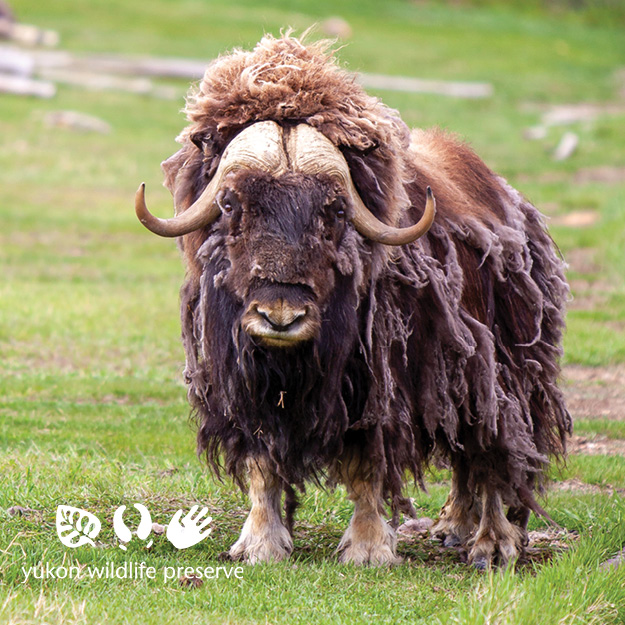
Operated by the University of Alaska Fairbanks, this research facility gives visitors guided, close-up looks at musk oxen, reindeer, and caribou living in natural enclosures as part of ongoing Arctic biology research. Guided tours explain how these species have adapted to Interior and Arctic conditions, making it as much a science lesson as a wildlife viewing stop. It’s a great place to see musk oxen up close.
Birch Hill Recreation Area
A locally loved network of trails on the edge of Fairbanks, Birch Hill is best known in winter for cross-country skiing and biathlon training (it’s hosted national-level events), but in summer it opens up for hiking, trail running, and mountain biking through rolling boreal forest. It’s less of a tourist draw than Pioneer Park or the museums, which makes it a good choice for visitors who want a taste of how locals spend their outdoor time.
Arctic Circle Tours
Crossing the Arctic Circle is a genuine bucket-list milestone, and several Fairbanks operators — including Northern Alaska Tour Company — run guided day and multi-day trips north along the Dalton Highway to the 66°33′ line, typically with a certificate to commemorate the crossing. Options range from single-day van tours to small-plane flightseeing trips and multi-day excursions that continue on to Coldfoot or the Brooks Range, available in both summer (near-endless daylight) and winter (aurora-focused) versions.
Dog Mushing Experiences
Fairbanks sits at the heart of Alaska’s mushing culture, home to the start of the Yukon Quest and a training ground for many Iditarod teams. Operators like Last Frontier Mushing Co-op, located halfway to Chena Hot Springs, offer both summer tours (on wheeled sleds) and winter dog sledding, along with kennel visits where guests can meet and help care for the dogs.
Hiking Near Fairbanks
Interior Alaska’s hiking looks different from the coastal trails in Southcentral or Southeast — expect rolling boreal forest, granite tors, and wide-open subarctic ridgelines rather than glaciers and fjords.
Angel Rocks Trail
Difficulty: Easy to Moderate
Distance: About 3.5 miles round trip (loop)
Elevation Gain: Roughly 900 feet
The most popular day hike near Fairbanks, about an hour east on Chena Hot Springs Road. The loop climbs through birch and spruce forest to a cluster of granite tor rock formations with wide views over the Chena River valley — often extended into an 8.3-mile point-to-point hike ending at Chena Hot Springs for those who arrange a shuttle.
Granite Tors Trail
Difficulty: Strenuous
Distance: About 15 miles round trip (loop)
Elevation Gain: Roughly 2,700 feet
A full-day commitment in Chena River State Recreation Area, this loop winds through boreal forest and alpine tundra to a dramatic cluster of granite tor formations — spires of exposed rock left behind as surrounding softer stone eroded away. It’s a serious undertaking best done as a long day hike in full daylight, which Fairbanks summers make easy.
Chena River Walk
Difficulty: Easy
Distance: Roughly 2–4 miles depending on route chosen
Elevation Gain: Minimal — flat riverside path
A flat, accessible path following the Chena River through downtown Fairbanks, connecting easily from the Morris Thompson Cultural Center. It’s less a wilderness hike than a pleasant, scenic walk with river views the whole way.
Ester Dome
Difficulty: Moderate
Distance: About 3–6 miles round trip, depending on trailhead chosen
Elevation Gain: Roughly 1,000–1,500 feet
A short drive west of Fairbanks near the small community of Ester, this rounded summit offers sweeping views over the Tanana Valley and, on clear nights, is a popular local spot for aurora viewing thanks to its open summit and distance from city lights. Multiple trailheads and old mining roads reach the top, giving hikers flexibility in route and distance.
Murphy Dome
Difficulty: Easy (via road) to Moderate (via trail)
Distance: Varies — several miles of ridge and summit trails
Elevation Gain: Roughly 1,500–2,000 feet from lower trailheads
Murphy Dome is unusual in that a road actually climbs to its 2,900-foot summit, making the sweeping 360-degree views over the Tanana Flats and White Mountains accessible even without hiking — while several ridge trails from lower parking areas offer a proper hike for those who want one. Its open, treeless summit makes it one of the best-regarded aurora viewpoints near Fairbanks.
Wickersham Dome
Difficulty: Moderate
Distance: About 3.3 miles round trip
Elevation Gain: Roughly 800 feet
Located about an hour north of Fairbanks along the Elliott Highway, this is the southern trailhead for the long-distance Summit Trail into the White Mountains National Recreation Area. A shorter out-and-back to the dome itself delivers open tundra views without committing to the full backcountry route, making it a good pick for visitors who want a taste of the White Mountains without a multi-day trip.
Where to Eat in Fairbanks
Fairbanks’ dining scene surprises a lot of first-time visitors with its diverse options. Alongside the expected Alaska seafood, the city has a deep Thai food scene, several well-regarded breweries, and a strong independent coffee culture built for long, dark winters.
Alaska Seafood & Interior Specialties
Wild salmon and halibut, shipped up from the coast, show up on menus across Fairbanks, and reindeer sausage, a true Interior Alaska specialty, is a common breakfast item and street-cart staple worth trying at least once. The Alaska Salmon Bake at Pioneer Park has served all-you-can-eat salmon, prime rib, and halibut in a casual outdoor setting for more than 40 years and is one of the most established dining traditions in town.
Thai Restaurants
Fairbanks has an unusually strong Thai food scene for a city its size, a legacy of Thai immigrants who settled in the area starting in the 1970s and ’80s. Multiple well-regarded, family-run Thai restaurants operate around town, and food writers covering Alaska have specifically called out Fairbanks’ Thai food as a highlight worth seeking out.
Breweries
Fairbanks’ brewery scene has grown steadily, with local taprooms pouring everything from classic pale ales to winter-appropriate stouts and porters. Most are small, low-key spaces that double as informal community gathering spots, and several are within walking distance of downtown hotels — a good way to spend a long summer evening or warm up on a dark winter one. Downtown, HooDoo Brewing Company is the city’s original craft brewery, known for classic European-style beers and a beer garden with fire pits. A bit further out, Silver Gulch Brewing & Bottling in the nearby community of Fox bills itself as America’s northernmost brewery, pairing local beer with hearty pub fare. Black Spruce Brewing Company, founded in 2018, has earned a reputation as one of the region’s most decorated breweries and is a good stop for its rotating, inventive brews.
Coffee Shops & Bakeries
With long winters this dark and cold, Fairbanks takes its coffee culture seriously. Independent espresso stands and cafés are common throughout the city. Local bakeries turn out fresh bread and pastries daily, and a stop at one is a good way to start any day full of sightseeing. Alaska Coffee Roasting Company, known locally as ACRC, is a longtime favorite for its coffee and homemade food, drawing everyone from studying students to business meetings. For pastries, The Crepery downtown is one of the city’s most consistently well-reviewed cafés, serving both sweet and savory crepes alongside coffee.
Alaska Native Culture in Fairbanks
Fairbanks sits within traditional Tanana Athabascan territory, and Alaska Native culture here is a ongoing part of the community rather than strictly historical.
Athabascan Heritage
The Tanana Chiefs Conference, based in Fairbanks, represents 42 member tribes across Interior Alaska and continues traditions of fish camps, subsistence hunting, birch bark basketry, and beadwork. Interior Athabascan groups historically moved seasonally along the region’s rivers, and that river-based way of life still shapes community events and subsistence practices today.
Cultural Centers
The Morris Thompson Cultural and Visitors Center is the best single introduction, with exhibits developed in partnership with Alaska Native organizations covering the land, seasons, and peoples of the Interior and Arctic. The Riverboat Discovery’s stop at a recreated Athabascan village adds a more hands-on layer, with live cultural demonstrations included as part of the tour.
Local Art
Alaska Native art is featured prominently in the Rose Berry Alaska Art Gallery at the Museum of the North, and locally made pieces are sold at shops around town, including the Morris Thompson Center’s gift shop. Buying directly from Native-owned shops and artist cooperatives is the most direct way for visitors to support the local Native art economy.
Traditional Practices
Subsistence fishing, hunting, and gathering remain active practices for Interior Athabascan communities, tied closely to the region’s rivers and boreal forest. The Large Animal Research Station’s work with reindeer and caribou also connects to traditional subsistence species that have long been part of Interior Native diets and culture.
Native Events
The World Eskimo-Indian Olympics, held annually in Fairbanks, brings together Alaska Native athletes from across the state to compete in traditional games testing strength, endurance, and agility — skills historically tied to hunting and survival. It’s one of the best opportunities for visitors to see Alaska Native culture celebrated.
Best Day Trips from Fairbanks
Fairbanks’ Interior location makes it a natural jumping-off point for the Arctic, Denali, and some of the state’s most dramatic road-accessible scenery.
Driving Time: About 1 hour east via Chena Hot Springs Road
A full-day or overnight trip built around soaking in the mineral hot springs, touring the Aurora Ice Museum, and exploring the resort’s geothermal power operation. In winter, it’s one of the most popular aurora-viewing destinations near Fairbanks.
Driving Time: About 15 minutes southeast via the Richardson Highway
A quick, family-friendly stop centered on the Santa Claus House, with year-round Christmas displays, a reindeer petting area at the Antler Academy, and novelty mail postmarked from “North Pole, Alaska.” It’s easy to combine with a Chena Hot Springs or downtown Fairbanks day.
Arctic Circle
Driving Time: About 5–6 hours north via the Dalton Highway (typically a guided tour rather than a self-drive)
Crossing the 66°33′ line is usually done as a guided day or overnight tour with an operator like Northern Alaska Tour Company, given the Dalton Highway’s remote, industrial-truck-route conditions. Tours typically include a certificate marking the crossing and stops at Yukon River overlooks along the way.
Driving Time: About 2–2.5 hours south via the Parks Highway (or by Alaska Railroad)
Fairbanks is actually closer to Denali than Anchorage is, making it a strong basecamp option for visitors who want to see the park without committing to an overnight stay, though many still choose to stay a night given the park’s size and shuttle bus tour lengths.
Dalton Highway
Driving Time: Starts immediately north of Fairbanks via the Elliott Highway
Alaska’s famed haul road to the North Slope oil fields is best known as the Arctic Circle route, but shorter self-drive trips as far as the Yukon River crossing or Finger Rock are feasible in a day for confident drivers with a suitable vehicle — gravel sections, limited services, and long stretches without cell coverage make preparation essential.
Castner Glacier Ice Cave
Driving Time: About 2.5 hours southeast via the Richardson Highway
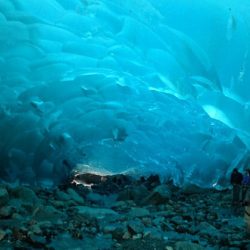
A moderate 2-mile round-trip hike leads to an ice cave at the toe of Castner Glacier, one of the more accessible glacier ice caves in Alaska reachable without a guide. It pairs naturally with a broader Richardson Highway day trip and is popular in both winter (blue ice cave photography) and summer.
Murphy Dome
Driving Time: About 45 minutes northwest via Murphy Dome Road
As a day trip rather than a hike, Murphy Dome is valued simply for the drive-up view — a road leads nearly to the 2,900-foot summit, making it one of the easiest wide-open panoramas near Fairbanks and a favorite for evening aurora viewing without any hiking required.
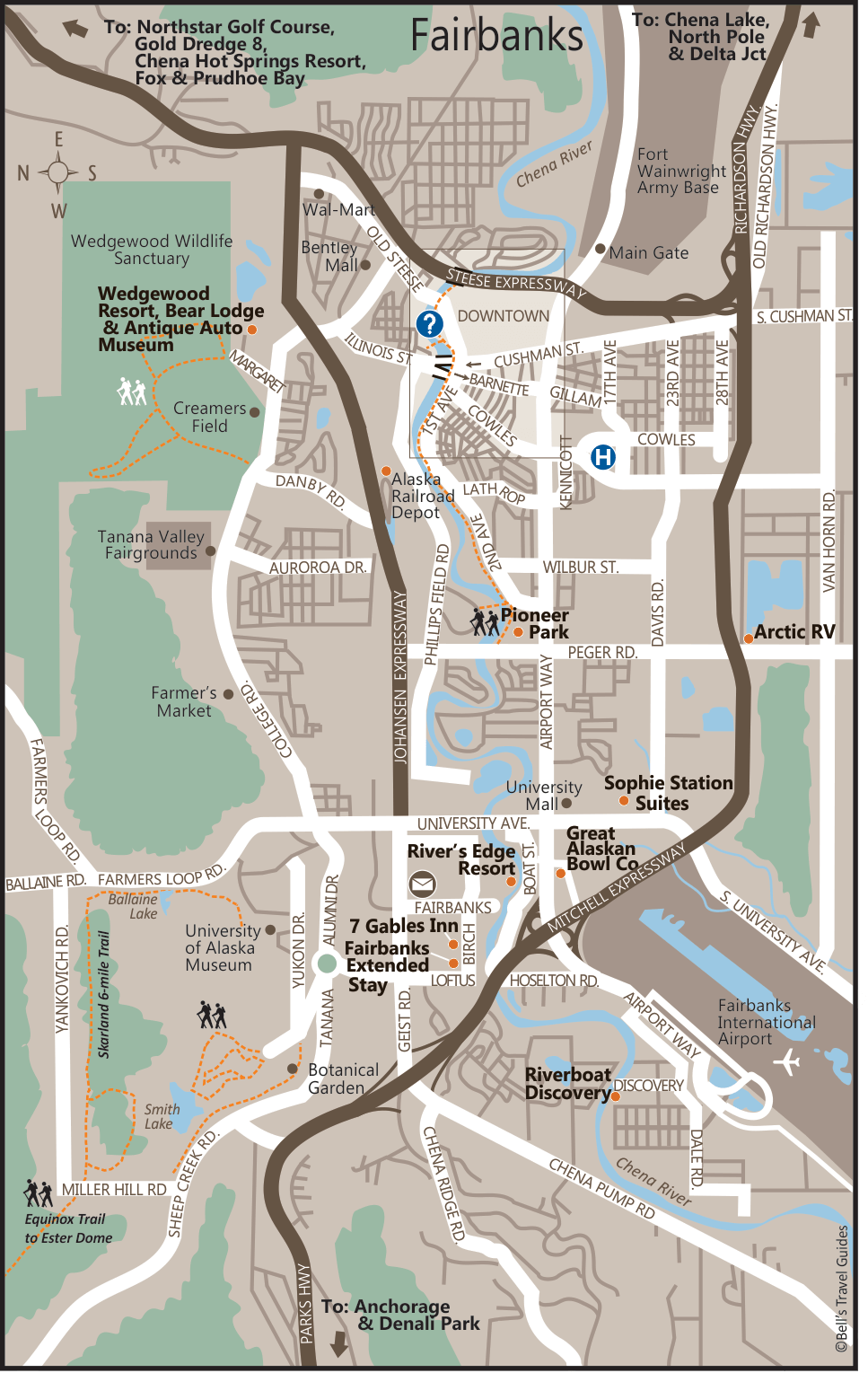
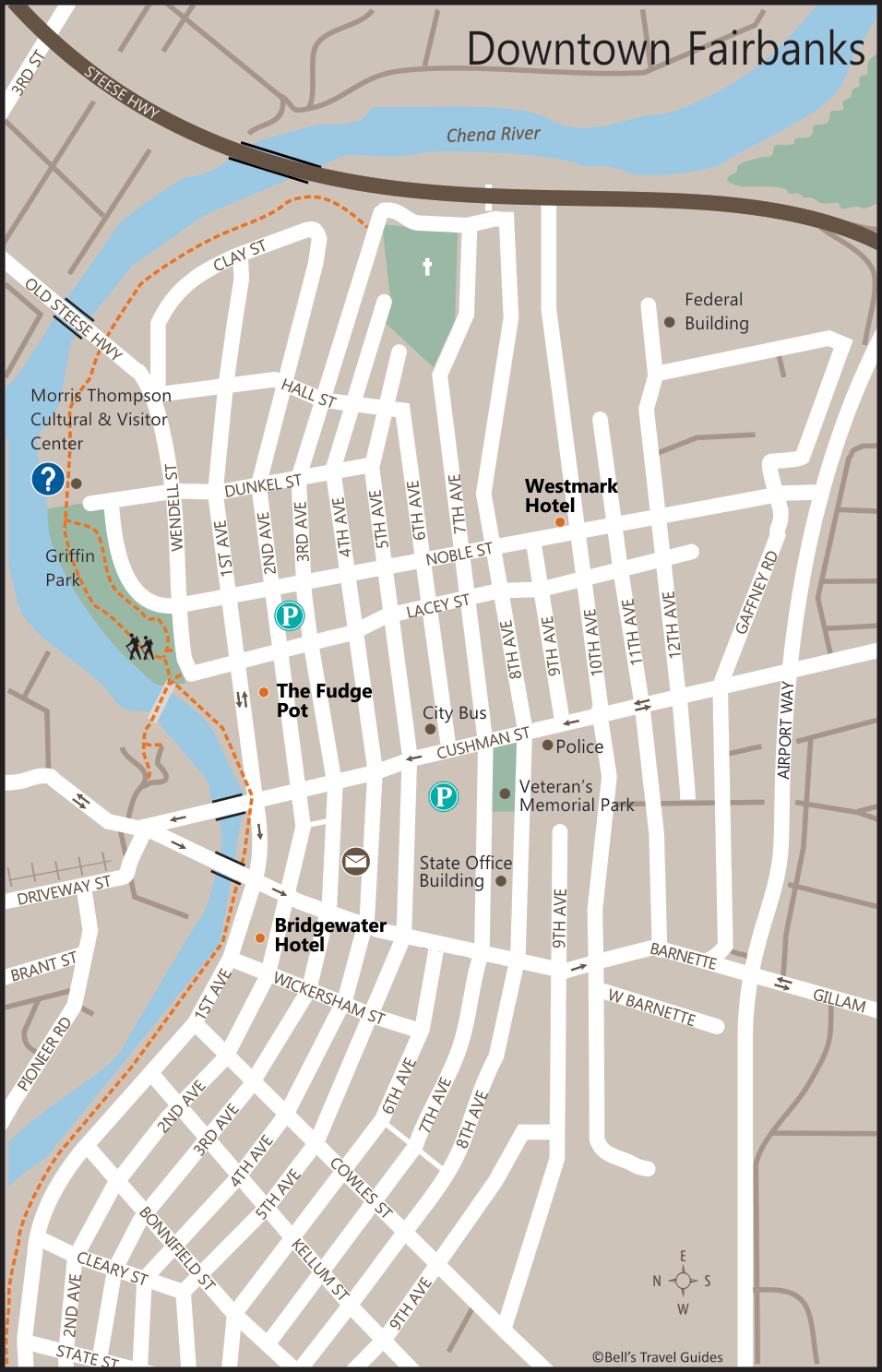
Fairbanks Alaska Map
We have two maps of Fairbanks Alaska. One shows all of Fairbanks and the other is a downtown Fairbanks map.
Fairbanks Map
Downtown Fairbanks Map
Fairbanks Alaska FAQS
What is Fairbanks Alaska Known for?
Fairbanks is known for is long summer days. It will see up to 21 hours of daylight in June and July, here in the land of the midnight sun. It’s also known for its incredible views of the Northern Lights (Aurora borealis) during the long winter days. The Aurora can best be viewed between October and April in this far north city.
Is Fairbanks Alaska worth visiting?
Absolutely Fairbanks it is worth visiting. Local attractions include:
How far is Fairbanks Alaska from Denali National Park?
Denali National Park is 120 miles south of Fairbanks on the Parks Highway.
How Far is Fairbanks from Anchorage?
Fairbanks is 358 miles from Anchorage on the Parks Highway. This is the fastest, most direct route between Anchorage and Fairbanks. However, it is possible to take the Richardson Highway to the Glenn Highway to travel between Fairbanks and Anchorage.
Alaska Travel Tips
Sign up for our 4-part email series to discover critical information for planning your ultimate Alaska vacation!